GeoGenesis
A projection laboratory for unfurling a 3D sphere into a flat map — continuous Pythagorean limb departure, multi-projection topology mutators, 24-bit RGB country hit-testing, and Great-Circle flight arcs.
10 entries · 2 codebases · 4 projections
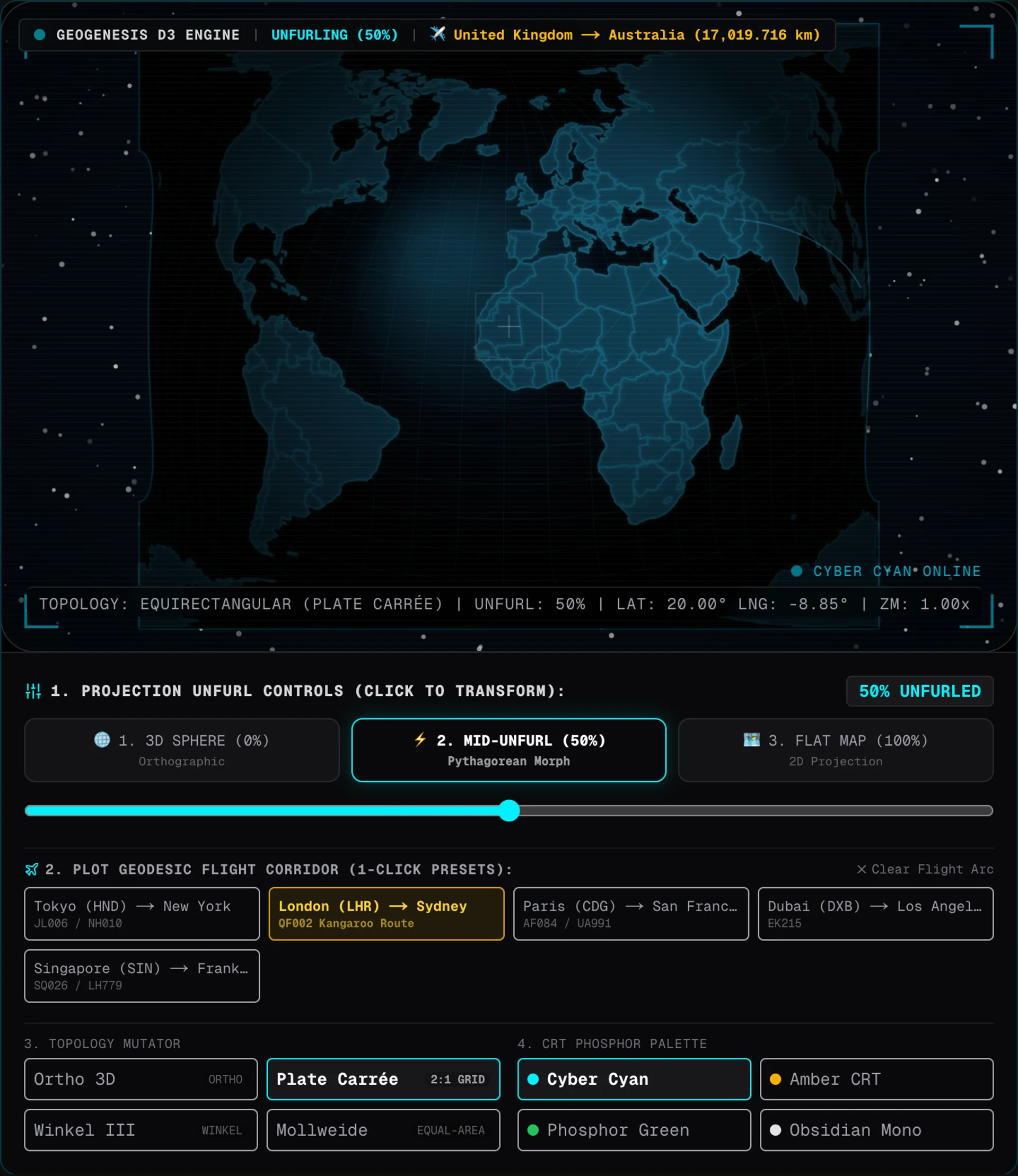
The sphere-to-plane problem has haunted cartographers for centuries, but for interactive rendering, unfurling the globe in real-time is the hardest part. You can easily draw a 3D orthographic sphere, and you can easily draw a flat equirectangular map, but bridging the two requires continuous geometric surgery on the fly.
As part of the broader Cartography project exploring rendering paradigms, GeoGenesis represents Paradigm 3: continuous projection mutators.
GeoGenesis exists as two distinct codebases because while the projection math is framework-agnostic, the rendering integration is not. The first variant is a 1,053-line single-file React component built around a raw HTML5 Canvas 2D render loop, proving that high-performance continuous morphing is possible without WebGL or Three.js abstractions. The second variant is an Angular 21 implementation that leverages signals and zoneless change detection to drive D3's projection pipeline.
What It Does
- Continuous unfurl from 3D globe (0%) to flat map (100%) with Pythagorean limb departure
- 4 projection topologies: Orthographic, Plate Carrée, Winkel Tripel, Mollweide
- 5 geodesic flight presets with Great-Circle Haversine SLERP arcs
- 24-bit bijective RGB country hit detection (under 0.05ms)
- 4 CRT phosphor color palettes
Technical Deep Dive
- Pythagorean limb departure: — sliding occluded points from sphere silhouette to equirectangular slots
- Dynamic horizon clipping:
- Winkel Tripel: Multi-projection topology mutator built with 4th-order Taylor sinc guards
- Mollweide equal-area: Solved via quadratic Newton-Raphson Kepler iteration in steps
- Angular 21 variant: Uses
d3.geoProjectionMutatorwith signal-driven zoneless change detection for frame-by-frame projection blending
What I Learned
The unfurl seam — where occluded back-face coordinates emerge into the visible front-face — is the hardest problem in this project. Every projection handles it differently, and none of them handle it cleanly. When you flatten a sphere, the points that were hidden behind it have to suddenly decide where they belong on the new 2D plane. You have to write specific mathematical logic to drag those hidden vertices across the limb boundary without them snapping or streaking across the screen. It's a continuous problem of mathematical classification that turns out to be far more complex than just interpolating between two shapes.
Related Threads
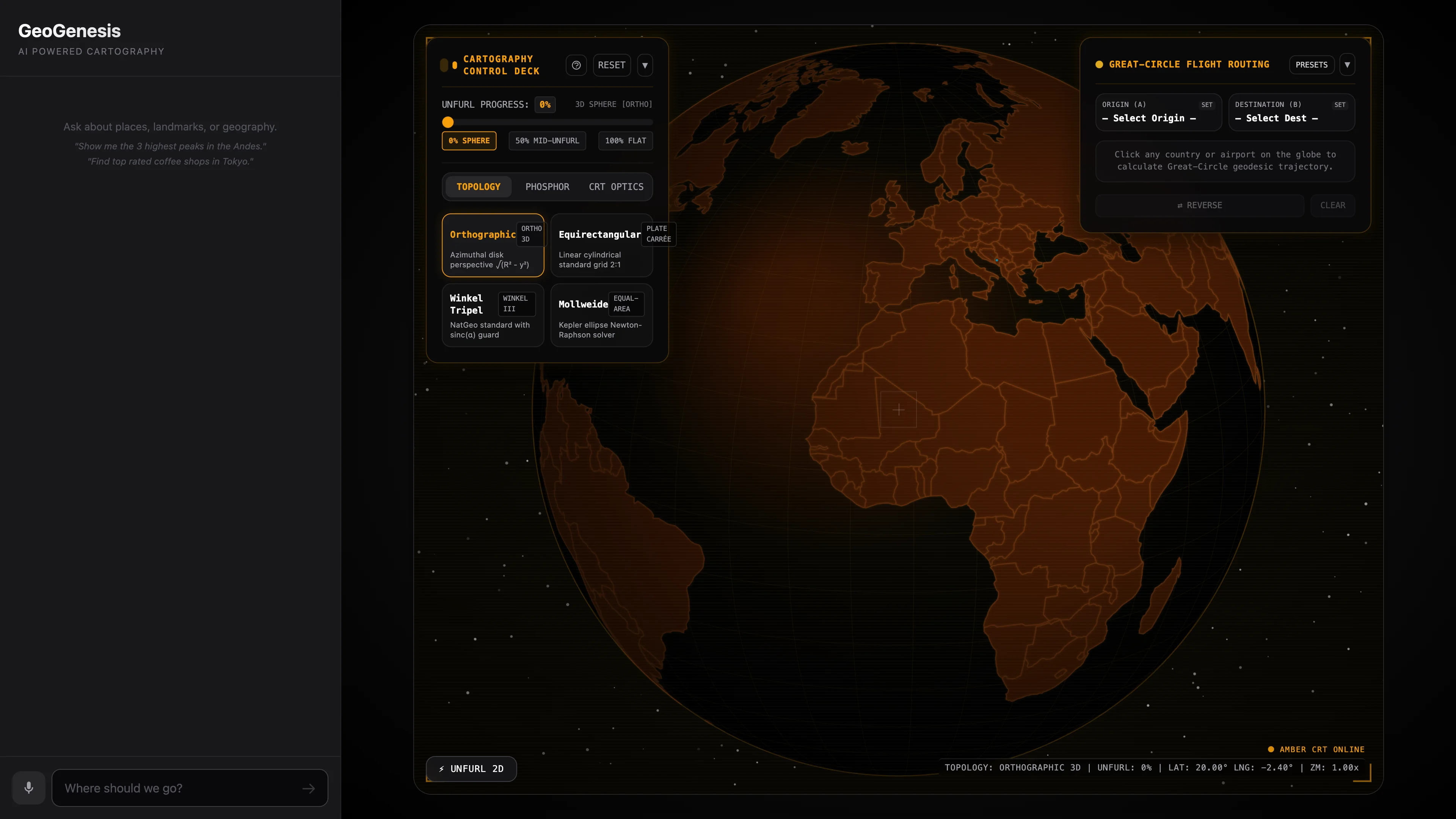
GeoGenesis: mathematical projection unfurling and geodesic routing
1,053 lines of Canvas 2D, continuous Pythagorean limb departure unfurling, multi-projection topology mutators (Winkel Tripel & Mollweide), 24-bit RGB country hit-testing, and Haversine SLERP flight arcs.
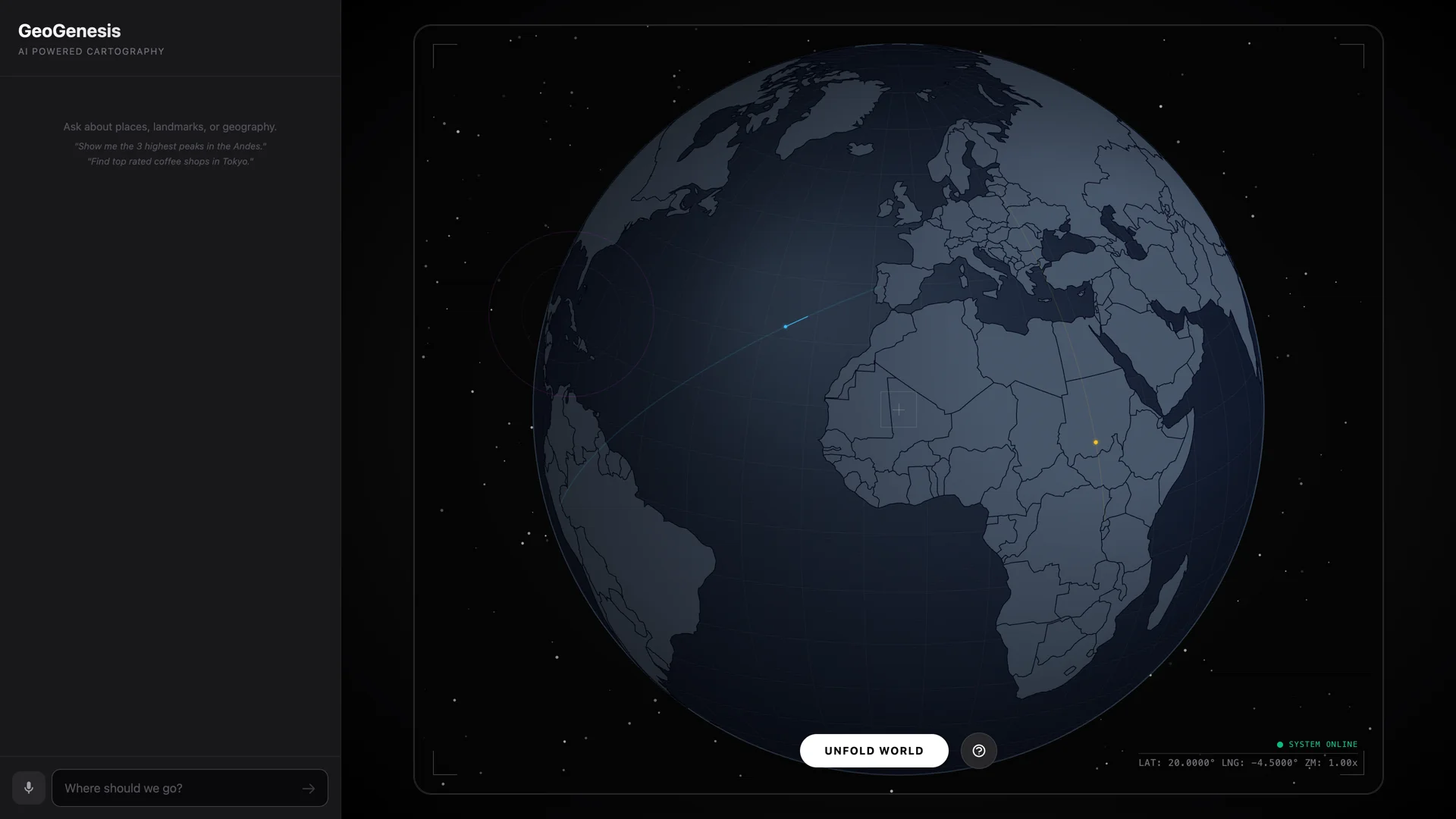
Building the GeoGenesis Unfold
An AI Studio D3 globe export becomes a buttery orthographic-to-equirectangular transition — through clip artifact rewrites, hemisphere math, and one very important minus sign.
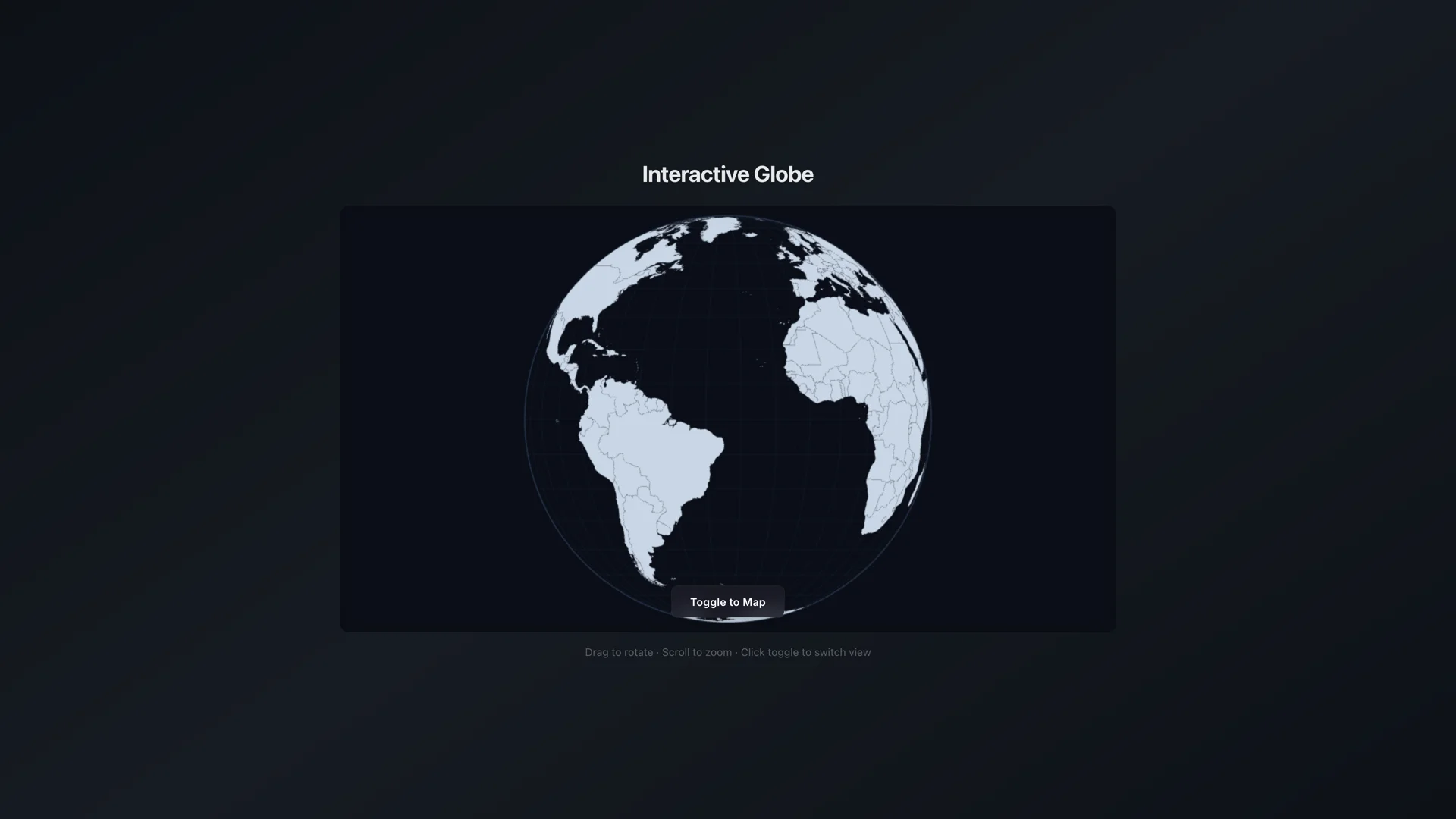
Interactive Globe
An AI Studio export with genuinely clever math — a custom D3 projection interpolator that unfurls a 3D globe into a flat map and back.