TerraGemini
918 lines of raw WebGL with zero Three.js abstraction — O(1) vertex buffer slicing up to 250,000 points, Blinn-Phong specular ocean glint, 3×3 Sobel coastline convolution, and MGRS geodetic telemetry.
8 entries · 250K vertices · 4 shader presets
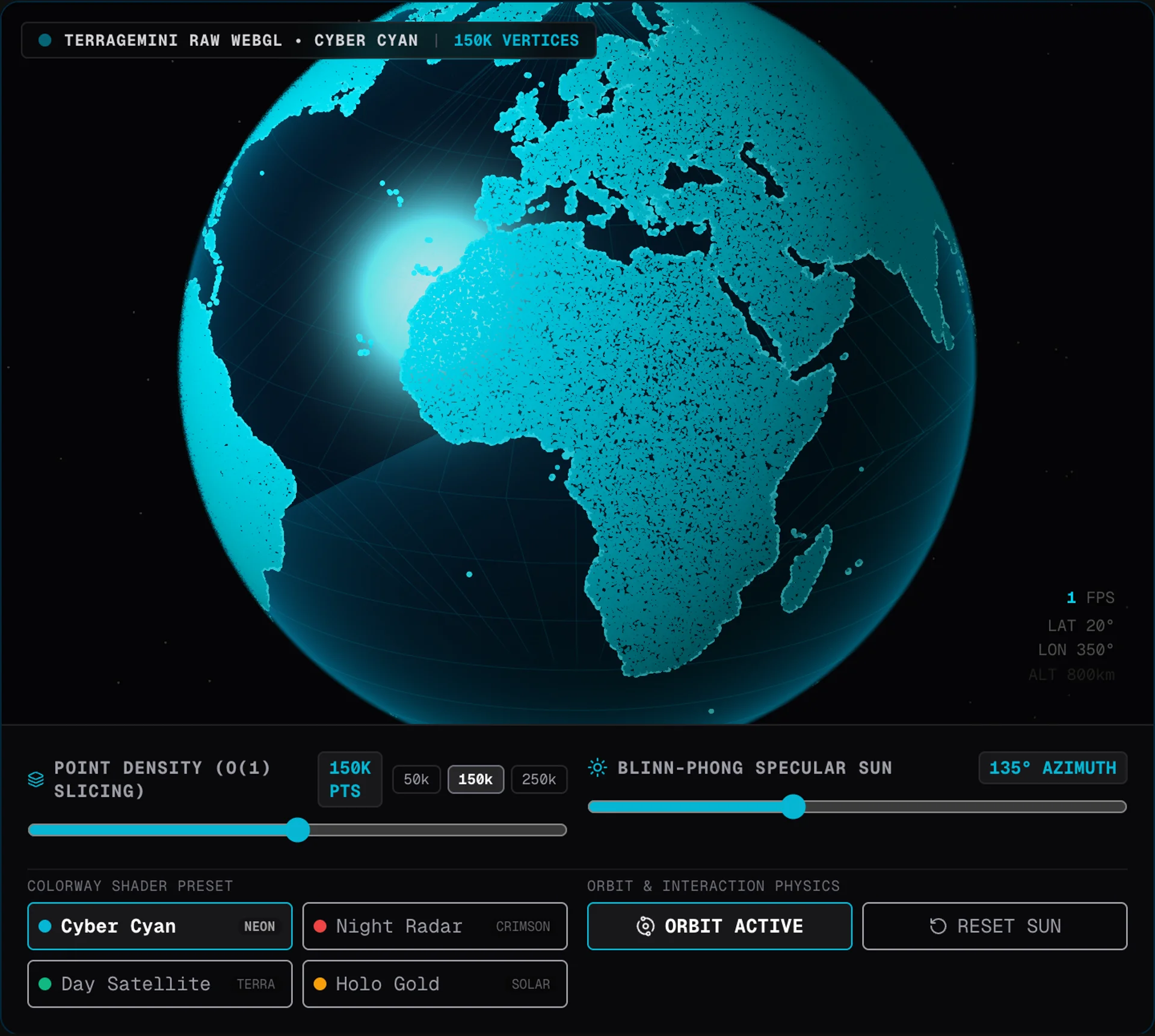
When Canvas 2D hits its ceiling around 50,000 animated points, you have to go to the GPU to maintain frame rates. This project skips Three.js entirely — 918 lines of raw WebGL, every buffer allocated by hand, every shader written from scratch.
TerraGemini serves as Paradigm 4 in the broader Cartography project, delivering the highest performance ceiling with zero framework abstraction.
Rather than relying on abstraction layers, TerraGemini uses direct gl calls to manage its state. Offloading calculations to GPU fragment shaders enables rendering hundreds of thousands of points, raytraced specular ocean glints, and procedural coastlines at 60fps.
What It Does
- Point density slider: 50K to 250K vertices dynamically without PCIe reallocation, using O(1) buffer slicing.
- Blinn-Phong specular ocean reflection: Raytraced ocean glint with a scrubbable 3D solar vector for precise azimuth control.
- 3×3 Sobel edge-detection: Dynamic convolution kernels extract crisp coastline boundaries procedurally.
- 4 colorway shader presets: Instant uniform vector lerping across Cyber Cyan, Night Radar, Day Satellite, and Holo Gold without recompiling.
- WGS84 to MGRS 1-meter geodetic telemetry: Full screen-to-sphere raycasting and forward projection with tactical HUD rings.
- Orbit physics: Momentum-based interaction for smooth, natural globe rotation.
Technical Deep Dive
- O(1) vertex buffer slicing: By pre-allocating a 250K
Float32Arrayon the GPU, scrubbing the density slider simply changes thegl.drawArrayscount without expensive reallocation or bus traffic. - Blinn-Phong reflection: Computed analytically on a billboard quad. The half-vector
H = normalize(L + V)powers the specular termmax(dot(N, H), 0)^shininess. - Sobel coastline: The fragment shader samples 8 neighbors in UV texture space, computes the gradient magnitude, and thresholds it to modulate point sizes for coastline pixels.
- The Three.js precursor (Rotating Earth): Proved the visual concept in ~50 lines of GLSL fragment shader, implementing a limb-angle atmospheric halo before TerraGemini took the engine to raw WebGL.
- Screen-to-sphere raycasting for mouse interaction: Unprojects the mouse vector into world space and solves the quadratic equation
|O + tD|² = R²for perfect surface targeting.
What I Learned
Writing raw WebGL is debugging with no safety net — no scene graph, no material system, no error messages beyond a black screen. But the payoff is total control: 250K points at 60fps with specular lighting that you tuned by hand. The Three.js version (Rotating Earth) proved the concept in 50 GLSL lines; TerraGemini proved it scales.
Related Threads
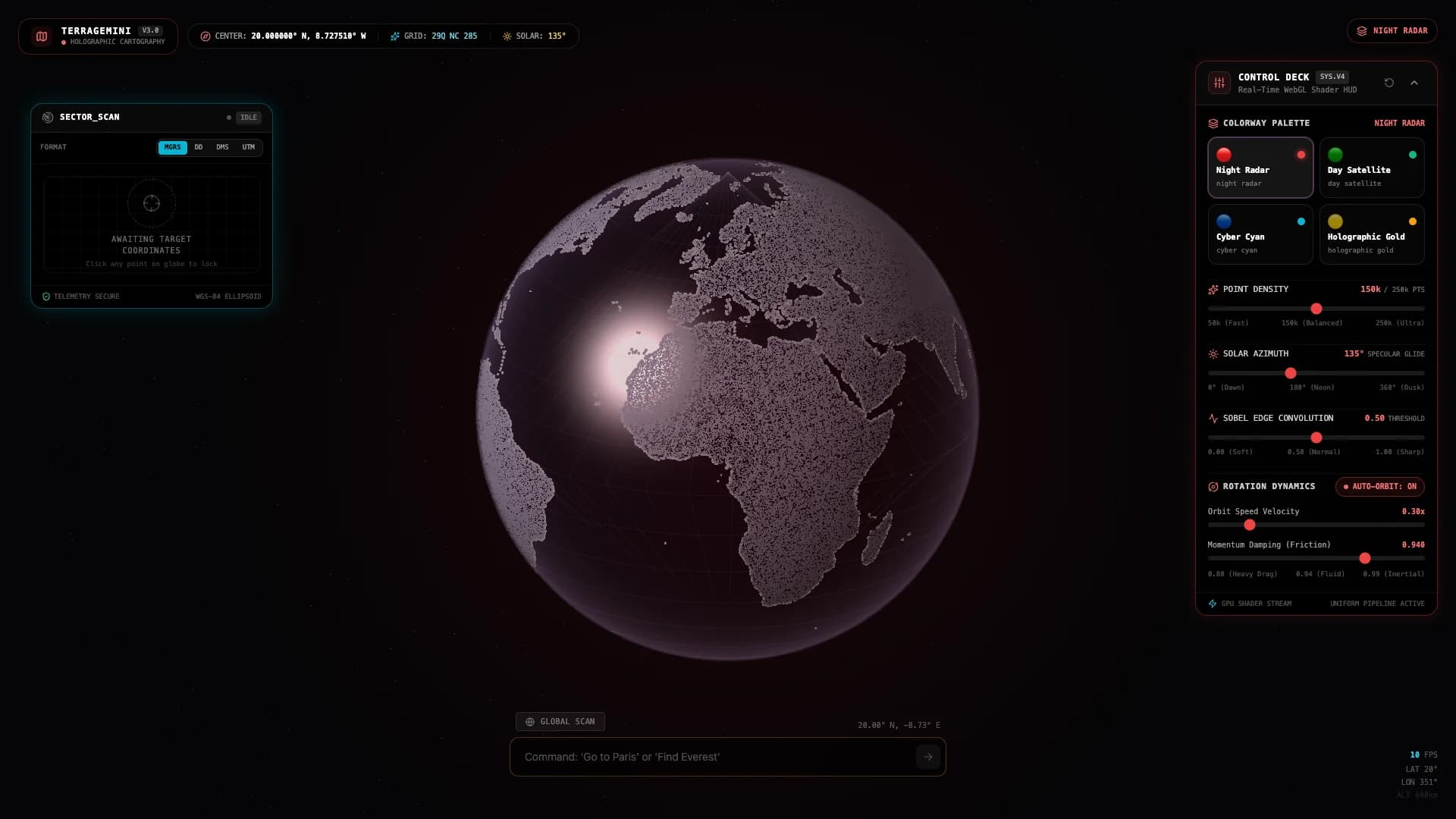
TerraGemini: raw WebGL globe and planetary telemetry
918 lines of raw WebGL, Blinn-Phong specular ocean glint, 3×3 Sobel coastline convolution, O(1) vertex buffer slicing up to 250,000 points, and military MGRS telemetry.
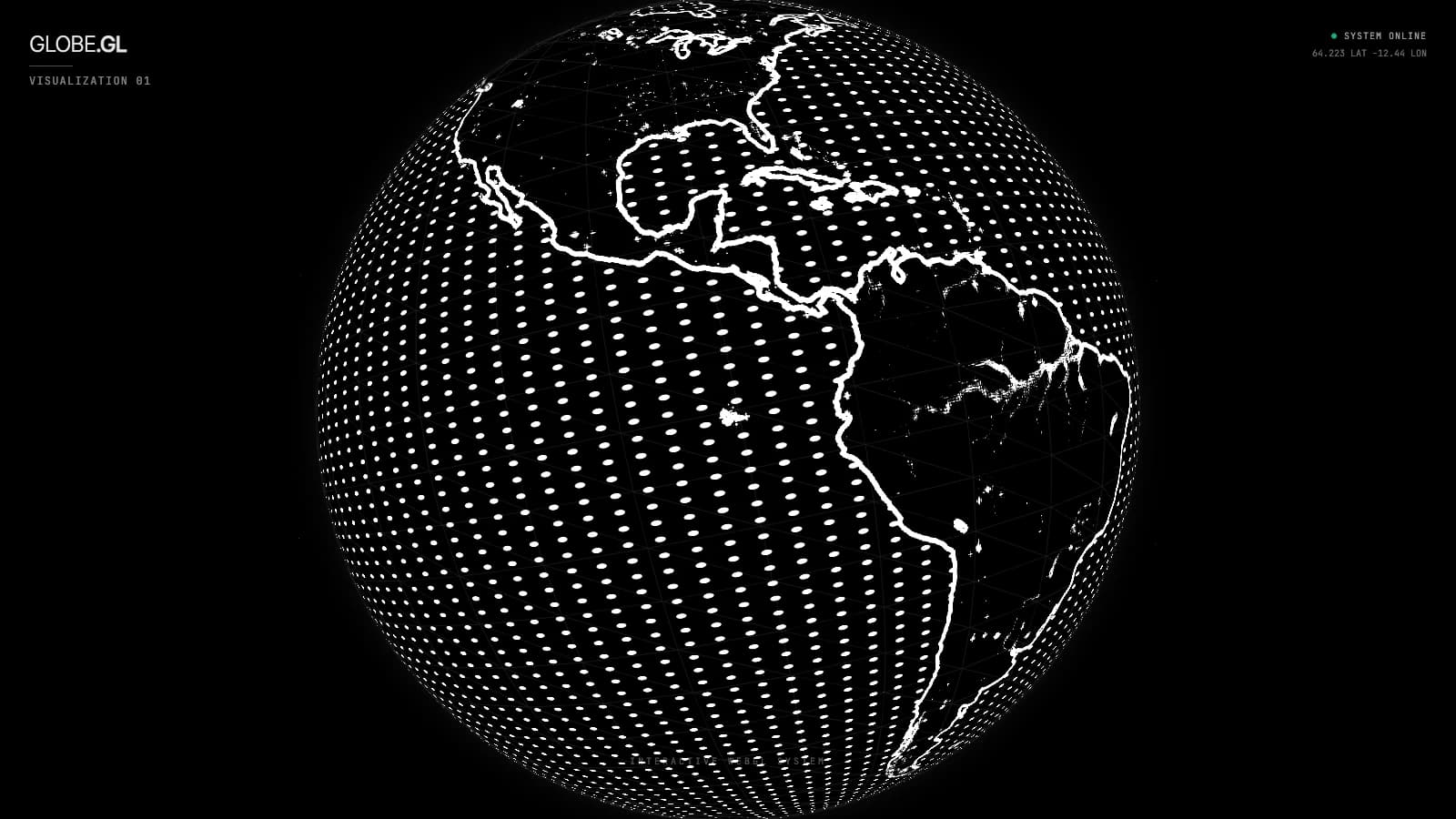
Dot-matrix globe: GLSL coastlines on a specular map
The easiest AI Studio rescue — a 3D rotating Earth built entirely in custom GLSL shaders. UV-space dot grid, Sobel coastlines, and atmospheric glow in ~50 lines of fragment shader.