OpenClaw + Gemma 4: Local Agent Pipeline
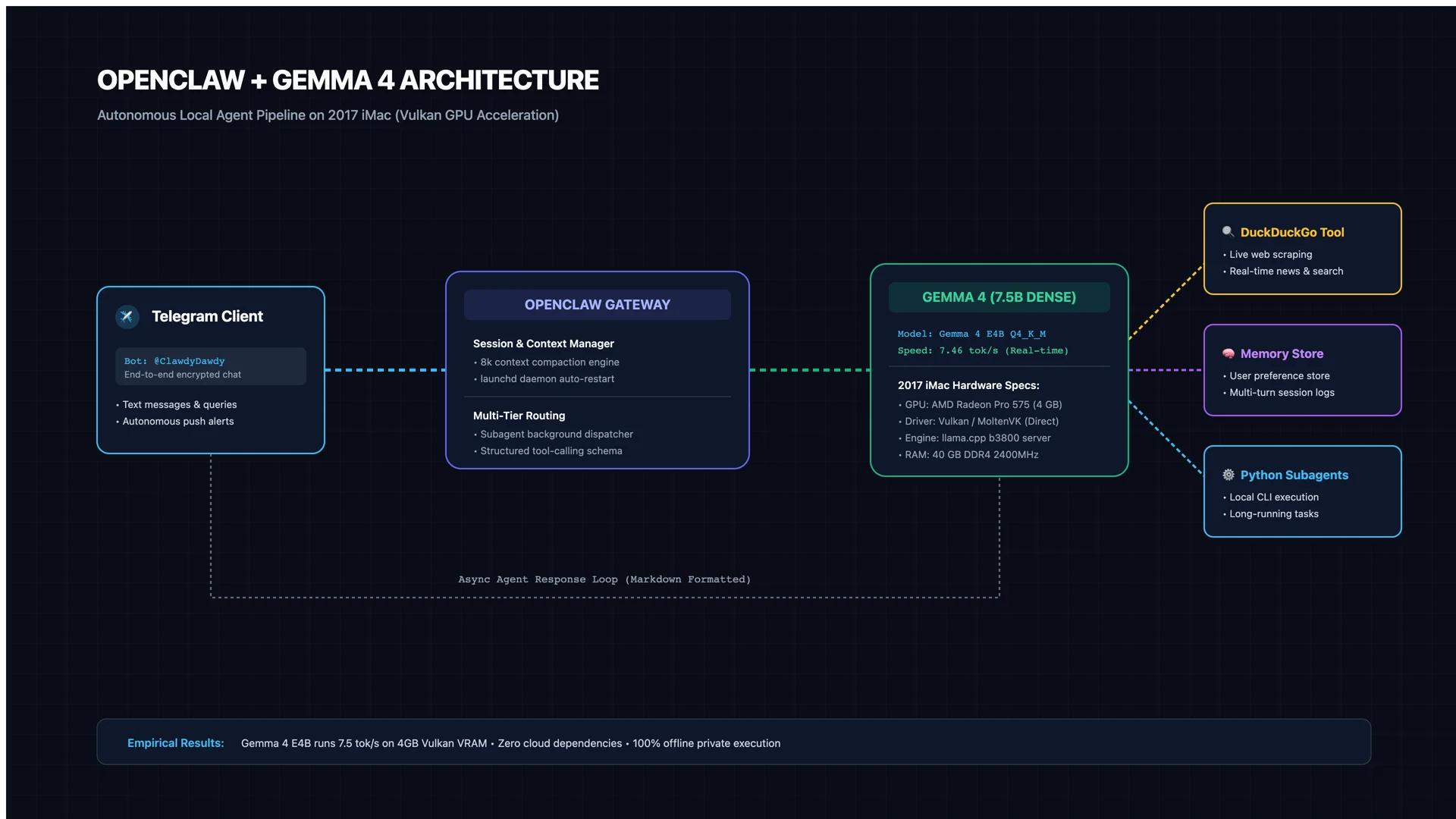
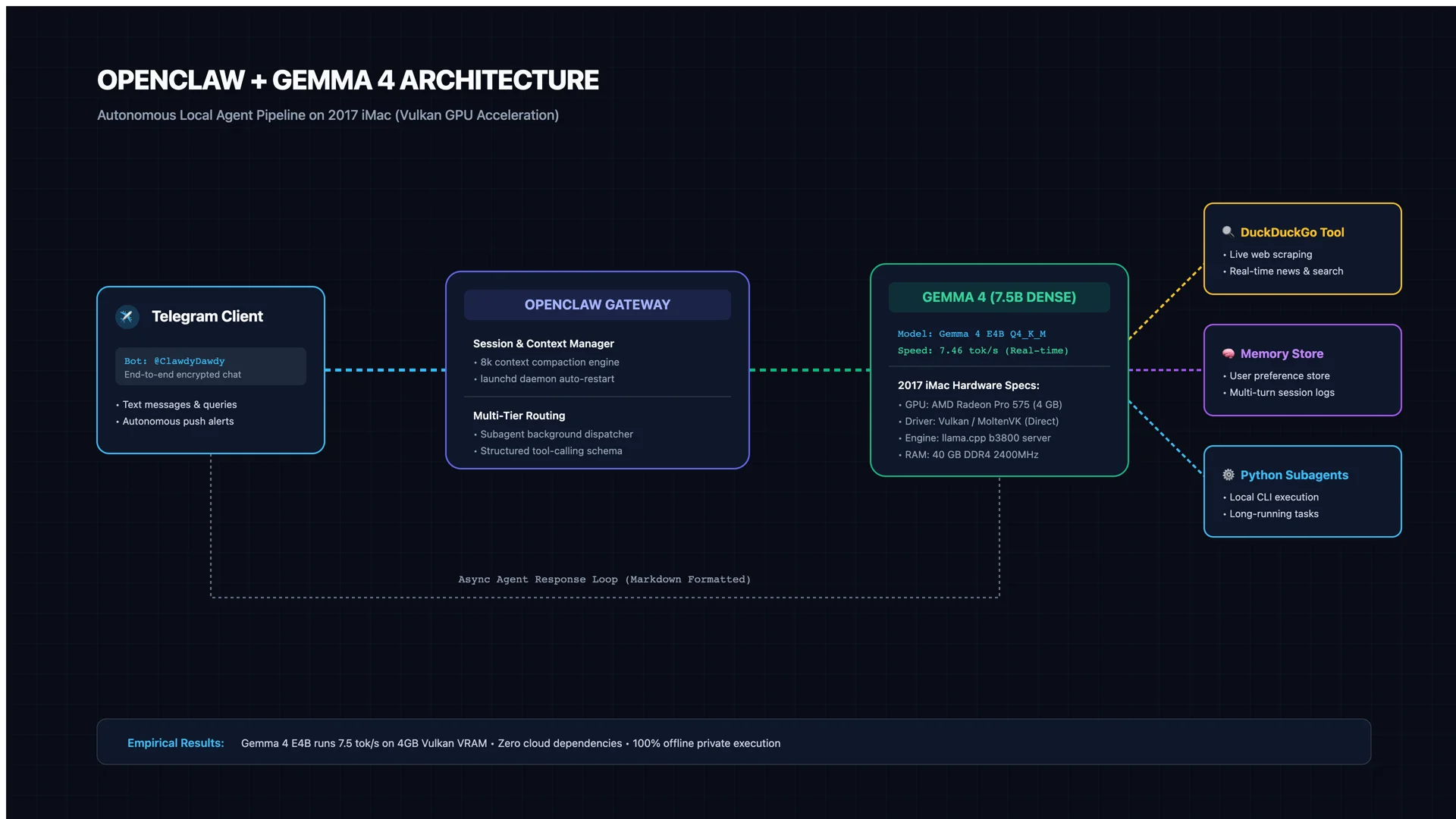
A 2017 iMac running an autonomous AI agent via Telegram. Vulkan GPU acceleration, DuckDuckGo web search, tool-calling chains.
7.5 tok/s · web search · Telegram bot
Building an autonomous AI agent that texts me through Telegram, searches the web, and runs entirely on consumer hardware. No cloud. No API keys. Just a 9-year-old desktop with a 4 GB GPU and some stubbornness.
The Stack
- Model: Gemma 4 E4B (7.5B dense · Q4_K_M · 4.5 GB)
- Inference: llama.cpp v38 (Vulkan/MoltenVK · 7.46 tok/s)
- Orchestration: OpenClaw (Gateway + tool-calling + compaction)
- Interface: Telegram Bot (ClawdyDawdy · web search · always on)
The Hardware
2017 iMac 27"
- CPU: i7-7700K
- RAM: 40 GB DDR4
- GPU: Radeon Pro 575
- VRAM: 4 GB GDDR5
The GPU runs via Vulkan/MoltenVK — not Metal (crashes on discrete AMD), not ROCm (Linux-only), not Ollama (can't see it). Three hours of empirical testing turned "worthless for LLMs" into "conversational speed for 7.5B models."
Milestones
Apr 6–10 — GPU Resurrection (Done)
Everyone said the Radeon Pro 575 was dead for LLMs. Metal crashes on discrete AMD GPUs. ROCm is Linux-only. Ollama can't see it. So I compiled llama.cpp with the LunarG Vulkan SDK — MoltenVK, the layer nobody tests — and the GPU appeared. E4B went from 7.3 tok/s (CPU) to 37.6 tok/s on Vulkan. 5.1× speedup from hardware everyone wrote off.
Apr 10–11 — 403 Tests, 4 Models, Zero Hand-Holding (Done)
Built an automated benchmark pipeline that ran overnight. 13 hours, no human intervention. The 31B model scored 94% despite everyone saying it couldn't run on this hardware. Published the full source code, every prompt, every grading function, every raw JSON result. MIT licensed.
Apr 12 — From Benchmarks to Bot (Done)
Wired up OpenClaw to the local Vulkan-accelerated llama-server and built a Telegram bot. The E4B model handles tool-calling flawlessly. We stopped testing models and started deploying agents. Named the bot ClawdyDawdy because why not.
Apr 14 — Full Pipeline Validated (Done)
Asked the agent to search the web for Google I/O 2026 dates. Seven minutes later, Telegram delivered the answer: May 19–20, Shoreline Amphitheatre, Mountain View. The full chain: Telegram → OpenClaw → Gemma 4 E4B on Vulkan GPU → DuckDuckGo search → formatted response → Telegram. All on a 2017 iMac.
Apr 14 — The MoE Bug Hunt (Blocked)
Tried to upgrade to the 26B-A4B MoE model for better quality. Both unsloth and bartowski quants produced infinite <unused50> tokens. Tested 7 configurations exhaustively. Discovered it's a Vulkan compute shader bug in MoE expert routing — the dense E4B works perfectly on the same binary. Filed reproduction data on llama.cpp #21516. Waiting for upstream fix.
Next — E4B Optimization & System Prompt Tuning (Active)
Making the daily-driver pipeline as good as possible. System prompt tuning for personality and brevity, multi-step agentic tasks (search → fetch → summarize), and reliability hardening for the Telegram integration.
Next — Tiered Model Routing (Next)
Running a fast E2B as the conversational router in GPU VRAM, delegating heavy research tasks to the E4B. Like having a receptionist who's quick with answers and a researcher who's thorough with analysis.
What Actually Works
- Validated Capabilities: Web search via DuckDuckGo, tool-calling chains, context compaction, Telegram bot, auto-restart via launchd.
- What Doesn't Work (Yet): 26B MoE models on Vulkan, Flash attention on AMD, Models over 4 GB VRAM.
Myths Debunked
- "You need Apple Silicon for local LLMs" — A 2017 Intel iMac with Vulkan runs Gemma 4 at 7.5 tok/s — fast enough for an autonomous agent.
- "20+ tok/s on 26B with --cpu-moe" — We measured 0.5–10 tok/s. And the output was garbage tokens. Performance claims without hardware specs are worthless.
- "Just use the bartowski quants, they fix the bug" — Tested bartowski Q3_K_M. Same
<unused50>tokens. The bug is in Vulkan's MoE shaders, not the quantization. - "--flash-attn works on AMD" — Flash attention requires Metal (Apple Silicon) or CUDA (NVIDIA). Not available on Vulkan.